
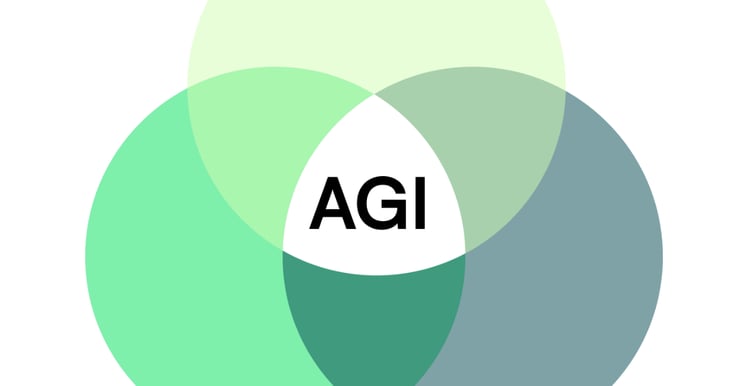
On a recent Uber ride to visit a customer, one of our top Innovation Center engineers, Deepesh Reddy, and I found ourselves deep in conversation about Artificial General Intelligence (AGI).
That part wasn’t surprising. We both work extensively in the Agentic AI space - this is what we think about every day.
What surprised me was this: Deepesh didn’t believe we would see AGI in our lifetime.
Ninety minutes later, as we stepped out of the car, we had both shifted our stance. Not only did we both believe we would see AGI in our lifetime, we became convinced that market forces will accelerate its arrival much sooner than any of us would expect.
Initially, I would have preferred to keep this debate internal, after all, the goal of Druid AI is not AGI. With that said, two recent developments made me reconsider:
-
Anthropic’s Dario Amodei publicly stated that AGI could arrive in 1-3 years.
-
Anthropic also recently updated its safety framework, removing certain responsibilities and guardrails.
When major players shift their tone and their safeguards, it’s worth pausing to reflect on what is actually happening.
If we have such a short runway to AGI, why remove guardrails now when we need them the most?
Market Forces.
So, here are the key insights, or #druidahha moments, from that 1.5-hour ride. Insights that will affect everyone building or using AI.
If you are only looking for the TLDR: The market is rapidly forcing AI systems to merge ideas, decision, and actions into self-improving autonomous engines – and if that convergence defines AGI, we may be sleepwalking toward it far faster, and with fewer guardrails, than we realize.
The Enterprise Before and After ChatGPT
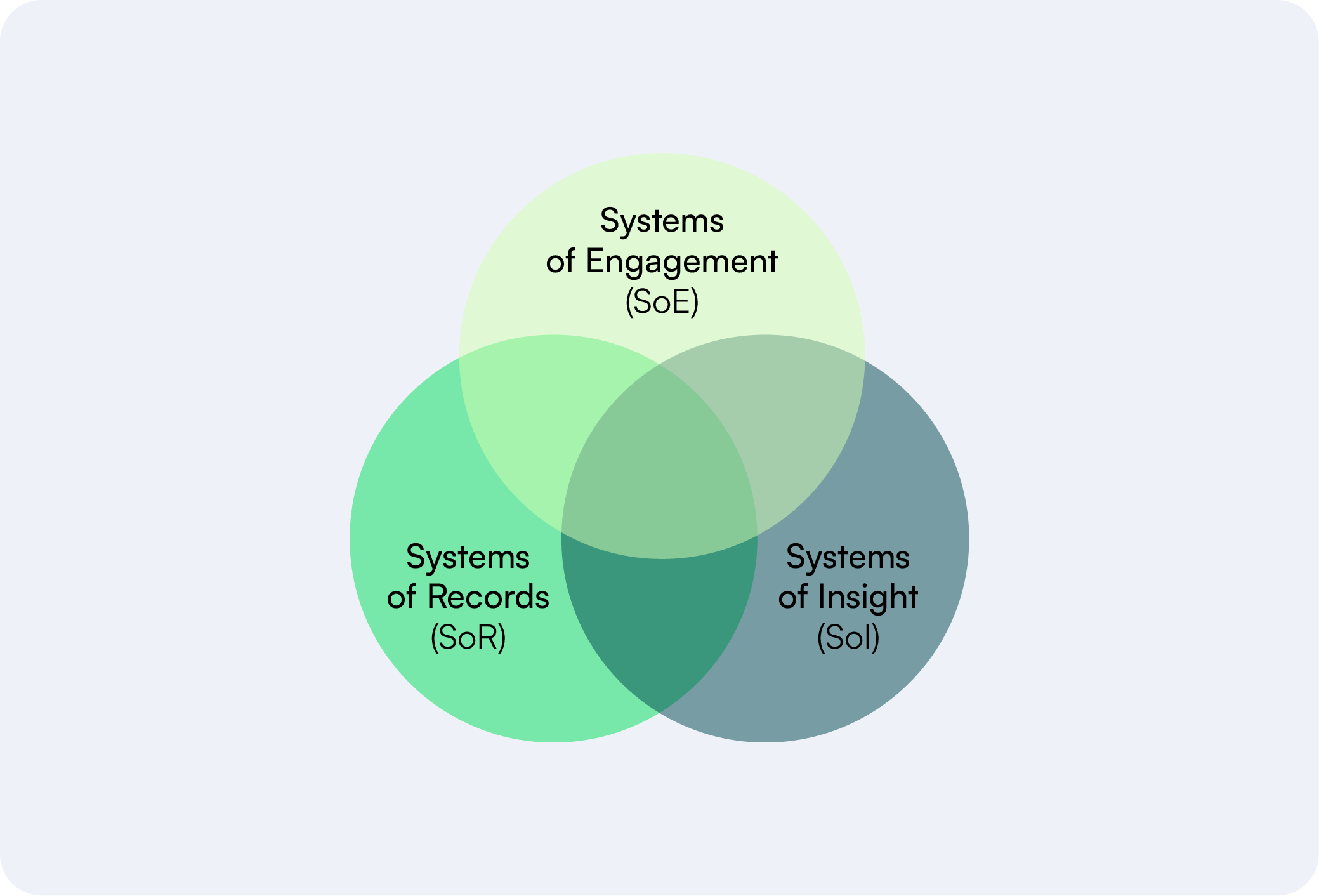
Before the public release of ChatGPT in November 2022, enterprise applications largely fell into two categories:
1. Systems of Record (SoR)
Authoritative sources of truth within an organization.
These systems become more powerful as more structured data is integrated, e.g. ERP, CRM, HRIS, CMDB
2. Systems of Engagement (SoE)
These serve to drive interactions with and between users to improve communication and collaboration. A term popularized by Geoffrey Moore in 2015, to which I even added my "two-cents” at the time on what differentiated the two systems from each other.
Systems of Engagement become more powerful as more users interact with them, think Facebook, LinkedIn, Slack, Teams, TikTok etc.
In 2016, I co-authored a six-part paper (now offline) in which I proposed a third category:
3. Systems of Insights (SoI)
Enterprise systems that generate predictive and prescriptive insights to bring new ideas to the end user.
Their power comes from generating high-quality content that drives the creation of new ideas. A simple example? Using Google Search to inspire yourself on a new creative endeavor.
You with me?
#druidahha - November 2022 Changed the Foundation
The fundamental shift after November 2022 wasn’t just better chat interfaces.
It was this:
Systems of Record no longer require purely structured data.
Historically, “source of truth” for enterprise systems meant structured, clean, controlled data — because correctness mattered.
But Large Language Models (LLMs) changed that.
Now:
-
Unstructured data becomes part of the “source of truth.”
-
Knowledge lives in embeddings, context windows, and probabilistic reasoning.
-
The boundary between structured and unstructured data collapses.
And here’s the consequence:
Everything built on top of the new SoR must be re-evaluated.
This is why building traditional applications and building AI agents are fundamentally different disciplines.
And more importantly:
The three system types - Record, Engagement, Insights - are beginning to merge.
#druidahha - The Emergence of Three New Enterprise Systems
With the proliferation of LLMs, new system archetypes are emerging — and in many cases, replacing traditional enterprise categories.
I’m not a marketer, so the naming convention may evolve. But for now, I see three: 1) Systems of Ideas 2) Systems of Decisions & Action 3) Systems of Experience.
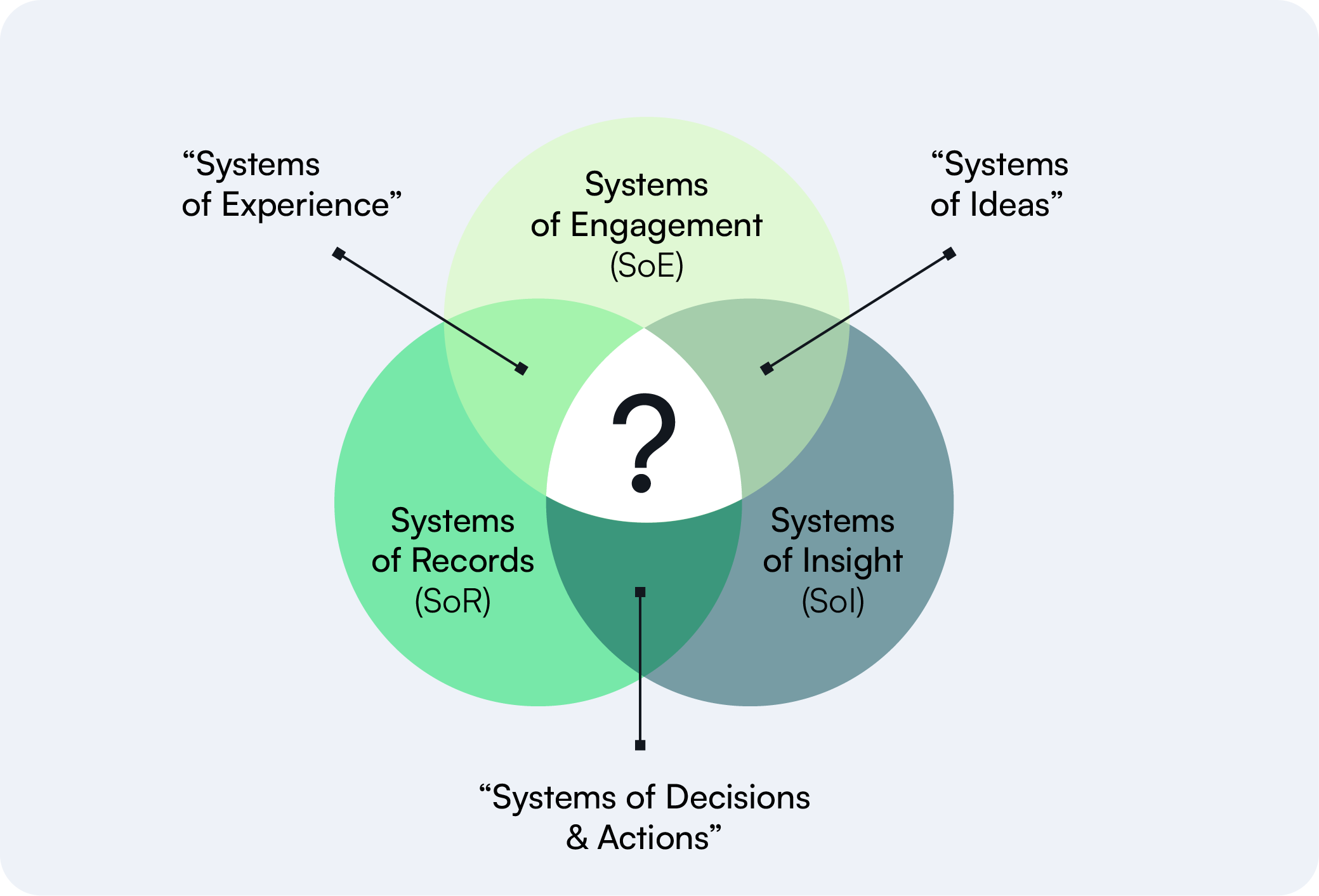
1. Systems of Ideas
These systems can directly generate and serve new ideas; text, images, code, designs, etc.
This is the primary domain of Generative AI today.
Because the output is “ideas,” there is some tolerance for imperfection. Creativity allows flexibility.
2. Systems of Decisions & Actions
These systems don’t just generate ideas.
Specifically, they can:
-
Make decisions.
-
Trigger workflows.
-
Execute tasks.
-
Interact with automation systems.
-
Operate toward defined goals.
This is the domain of Agentic AI.
And here, there is almost zero tolerance for:
-
Inaccuracy
-
Security flaws
-
Compliance violations
-
Incorrect execution
This is an AI used for operations. These systems trigger workflows, move money, update records, and act toward defined goals.
3. Systems of Experience
These systems orchestrate personalized experiences or journeys for users - even though the purpose of that personalization is to ultimately close a transaction as quickly as possible.
Their purpose:
-
Deliver tailored experiences.
-
Guide users toward specific outcomes.
-
Optimize interaction in real time.
They are primarily powered by Conversational AI.
While there is slightly more flexibility than in Systems of Decisions & Actions, these systems still require very high levels of accuracy, correctness, security and compliance.
Because ultimately, they are tied to transactions.
The Market Is Forcing Convergence
In conversations with customers and partners, this framework has consistently clarified something important.
Technologies evolve.
But the “job” AI performs for enterprises does not change dramatically from these types of systems.
Every AI company - including Druid AI - will be pulled by market forces to fulfill one or more of these system roles.
At Druid AI, we serve:
-
Systems of Decisions & Actions
-
Systems of Experience
But the real question is not about this framework.
The Center of the Venn Diagram
If AI can:
-
Generate its own ideas (Systems of Ideas),
-
Make and execute decisions (Systems of Decisions & Actions),
-
Optimize interactions with individuals (Systems of Experience),
Then what sits at the center of that Venn diagram?
What do we call a system that thinks, decides, acts, adapts, optimizes interaction and improves itself? If every AI company is being pushed by the market toward one or more of these capabilities or systems…How much time do we really have? How long before the convergence is inevitable?
And if that convergence defines AGI — then perhaps the timeline isn’t driven by philosophical breakthroughs.
Perhaps it’s driven by market demand.
The Uber ride has ended, and fortunately it sounds like Anthropic will still ultimately stand its ground. But the implications are just beginning, and the runway may be far shorter than we think.