Data security and privacy
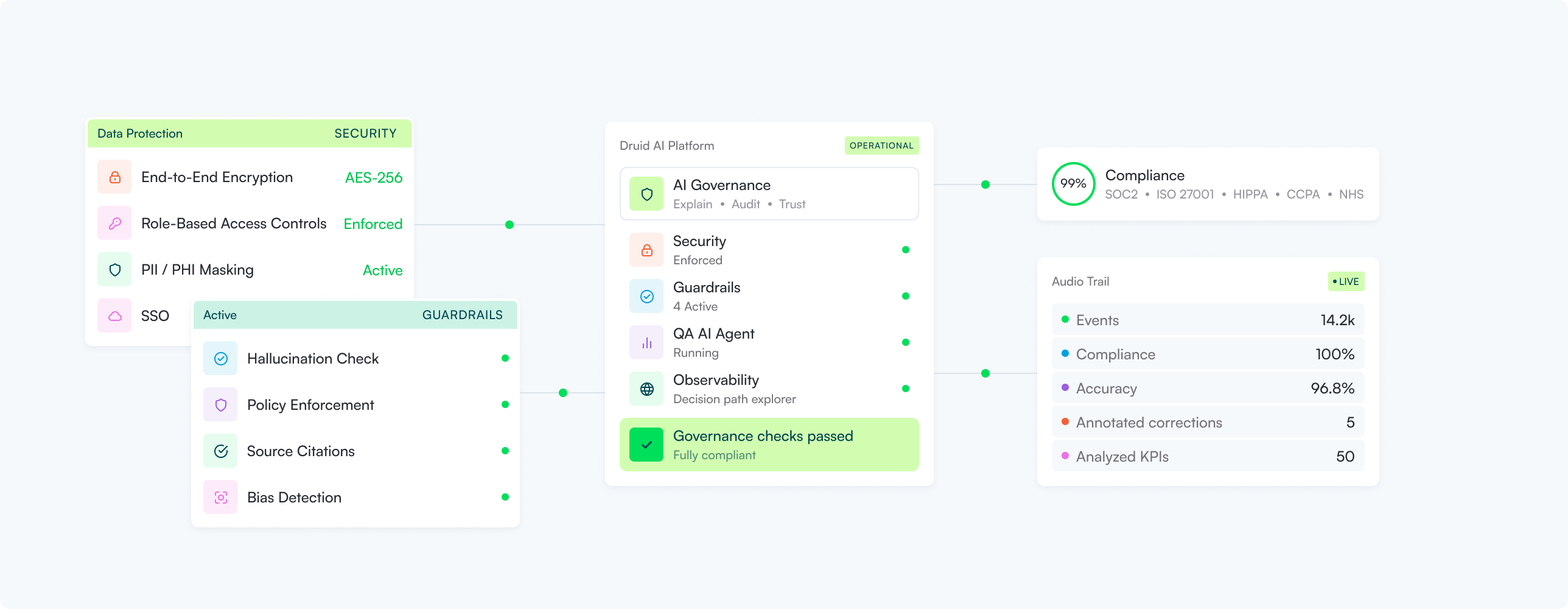
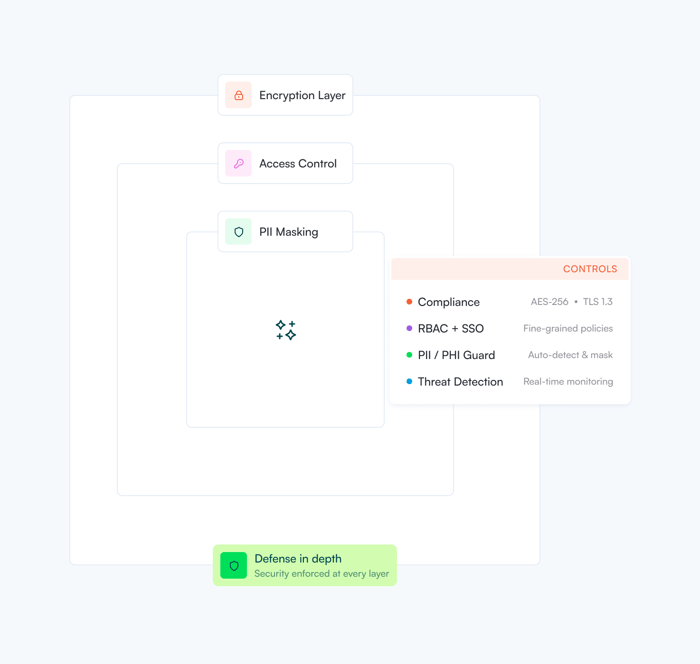
Protect data, identity, and access at every layer. Druid spans controls across the full runtime, from user access to system communication to stored knowledge and operational monitoring.
End-to-end encryption
Use TLS 1.2+ for communications, AES-256 for stored data and knowledge, and customer-managed key options for regulated deployments.
Role-based access control and identity
Apply RBAC, SSO with Active Directory and Okta, attribute-based and time-bound access rules, and knowledge segmentation across teams and geographies.
PII and PHI protection
Mask, anonymize, and tokenize sensitive data while enforcing consent management, deletion workflows, and residency rules so protected data never surfaces where it should not.
Real-time monitoring and threat detection
Combine behaviour based threat detection, anomaly alerts, MFA, forensic logs, and incident-response workflows into continuous runtime protection.
AI evaluation and guardrails
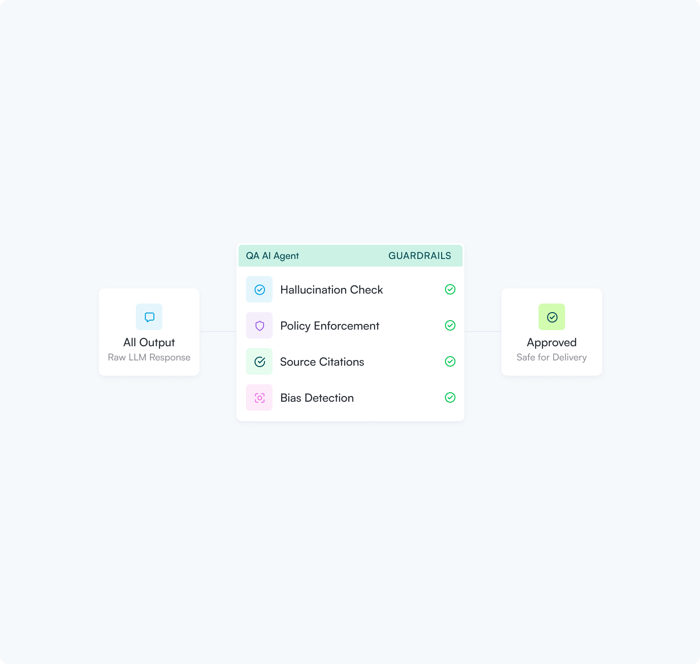
Your AI follows rules every time. Control the risks that come with generative AI, including hallucinations, prompt injection, data leakage, bias, and unauthorized access, through guardrails that are native to the platform rather than bolted on later.
Hallucination prevention
Ground every response in verified enterprise data with Graph RAG, source citations, and validation against authoritative knowledge before output reaches the user.
Content moderation and policy enforcement
Filter off-limit topics and keywords by company policy, agent, intent, and business domain with enforcement that stays consistent across every channel and conversation.
AI quality, testing, and accuracy
Test every flow before your customers do, then keep improving. Druid's QA capabilities validate agents before launch, catch drift in production, and close the loop between insights and model improvement automatically.
Automated QA Agent
Run persona-based tests, A/B comparisons, and regression suites across every conversation flow with scheduled validation on model updates or flow changes.
Measurable accuracy end to end
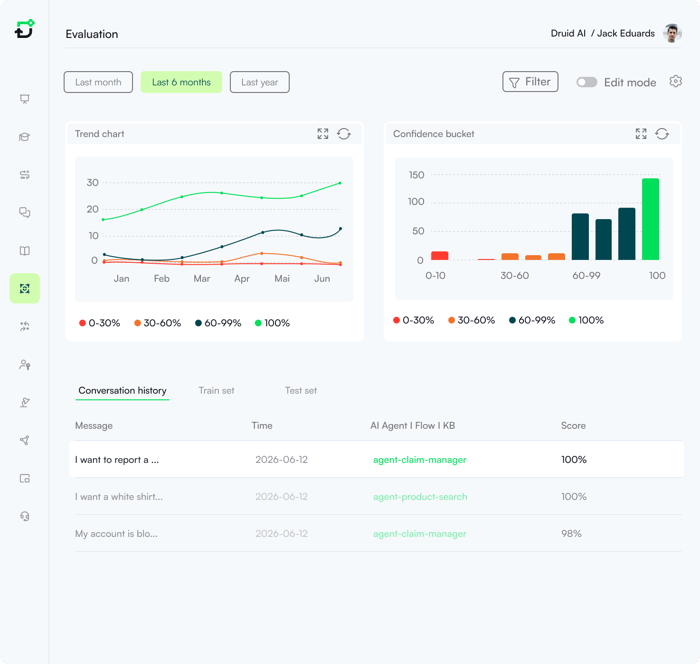
Track precision, recall, and confidence by intent, language, and environment with drift detection and trend visibility. Feed low-confidence utterances, annotated corrections back into training and test sets to compound accuracy over time.
Train logs and validation metrics
Access full training logs, validation metrics, and model performance history with alerts when defined thresholds are crossed.
RAG grounding and output guardrails
Score every generated response against the approved knowledge base, enforce citation rules, and block unsupported claims before they reach users.
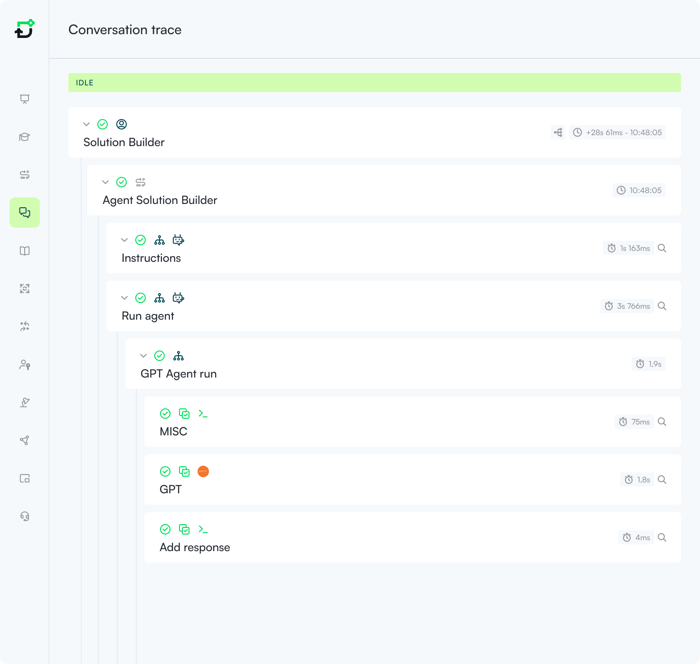
Observability and Explainability
Decision paths, not black boxes. Trace every step in an agent's reasoning from first message to final action with visibility that enterprise audit, compliance, and ML teams can actually trust.
Decision Path Explorer
Render the full reasoning chain for every interaction, including intent scores, retrieval sources, business rule evaluations, routing decisions, API calls, payloads, and latency.
Conversation history
Analyze conversation with full context, timestamps, searchability, and annotations so teams can inspect outcomes and feed corrections back into training.
LIME-based explainability
Inspect which input features drove each intent match with feature-level attribution so auditors and ML teams can see not just what the agent decided but why.
Activity history and audit trail
Capture every configuration change, model update, threshold adjustment, and guardrail trigger with exportable structured reports filtered by date, agent, intent, or compliance category.
50+ analytics KPIs
Track volumes, response times, satisfaction automation, and ROI through custom dashboards, filterable by department, agent, channel, or intent.
Compliance across models and geographies
Meet enterprise compliance without slowing deployment. Make secure deployment practical across geographies, cloud, hybrid, and on-prem environments while keeping the same control framework and operational model.
Compliance certifications
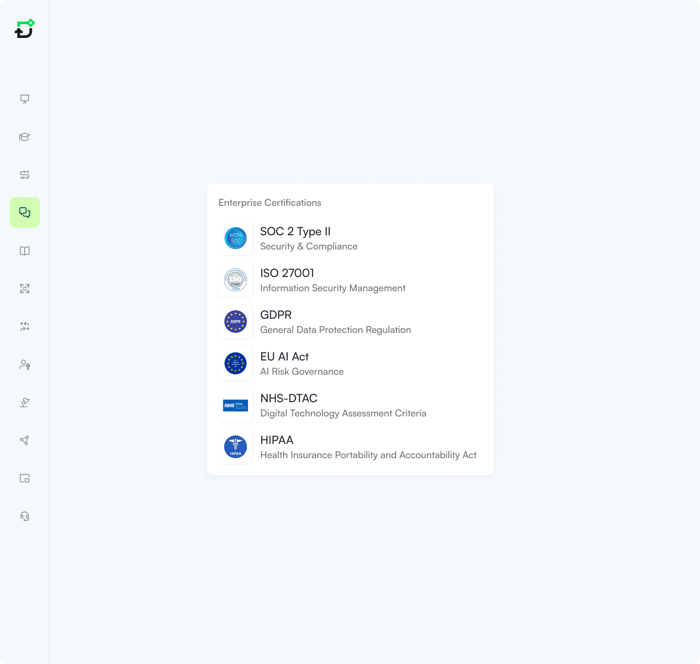
Support SOC 2 Type II, ISO 27001:2022, GDPR, EU AI Act, CCPA, HIPAA, NHS DTAC, and related enterprise requirements through a documented control framework that is audited and continuously validated.
Data governance across deployment models
Deploy in cloud, on-prem with air-gapped Druid Becus LLM, or hybrid topologies so sensitive data stays where enterprise policy or geography requires without changing the security model.
Bring your own LLM
Choose Azure OpenAI, Claude, Gemini, LLaMA, Mistral, Druid Becus etc. or bring your own LLM model and switch providers without rewriting agents while keeping data out of third-party model training loops.