

Here is something I did not expect when I started mapping healthcare intake workflows two years ago. Despite all the investment in portals, apps, chatbots, and patient engagement platforms, the phone is still how most patients access healthcare.
Not some patients. Most patients. Especially the ones who are older, less digitally fluent, or dealing with something urgent enough that typing feels too slow. And especially the ones calling to reschedule, check on a referral, or ask something that should take 30 seconds but takes 15 minutes because of the queue.
That is why AI voice agents for healthcare matter more than most digital health conversations acknowledge. The bottleneck is not digital. The bottleneck is the phone. And the phone is still the primary access channel for the majority of provider organizations.
The phone problem is not volume. It is what happens during the call.
I have talked to operations leaders at mid-size and large health systems who know exactly how many calls their access team handles per day. They track abandonment rates, average handle time, hold times. They have dashboards.
What they usually do not have is a breakdown of what those calls actually contain.
When you look at it, the pattern is consistent. Somewhere between 60% and 80% of inbound patient calls are one of five things: booking an appointment, rescheduling an appointment, canceling, confirming, or asking about basic logistics like location, hours, or parking.
None of these require clinical judgment. None of them require a trained coordinator. All of them require a human today because the systems behind the phone have not changed in a meaningful way since the IVR was bolted on 15 years ago.
That is not an access problem. That is a design problem. And it is expensive. A single patient call that takes 7 minutes of coordinator time, multiplied across 300 to 500 calls per day, is a full team doing work that should not exist.
Why text-based automation does not close the gap alone
This is where I need to be direct, even though it means complicating the story we tell as a platform company.
Text-based automation works. I wrote about it in the context of patient intake automation AI and covered patient scheduling automation AI. For patients who prefer chat, SMS, WhatsApp, or web portals, those flows are mature and they deliver real results.
But text-only automation has a reach ceiling. It self-selects for patients who are digitally comfortable, who have smartphones, who are willing to type, and who interact during the hours when they think to open an app.
The patients who call, and there are a lot of them, are not choosing the phone because they love hold music. They are choosing it because it is the interaction mode they trust, it is immediate, and it does not require navigating anything. For elderly populations, for patients with limited English, for anyone dealing with an urgent or stressful situation, voice is not a fallback. It is the preference.
So if you automate everything except the phone, you have improved access for the patients who needed it least and left the highest-friction channel untouched.
What an AI voice agent actually does
Let me be specific because I have seen too many vendor demos that show a synthetic voice reading a script and call it “voice AI.”
An AI voice agent for healthcare is a conversational system that handles a real phone call, end to end, without routing to a human for the standard scenarios. That means:
The patient calls. The agent picks up. It understands natural speech, not touch-tone menus. The patient says “I need to move my appointment with Dr. Patel from Thursday to next week” and the agent processes that as a reschedule request, pulls up the record, checks availability, offers alternatives, confirms, and updates the EHR. Call done.
Appointment booking works the same way. The agent collects what it needs through conversation, not through a form or a menu tree. Specialty, provider preference, location, insurance compatibility, available slots. The patient talks. The agent listens, responds, and acts.
Insurance verification can happen during the same call. The agent collects the policy number, runs eligibility in real time, and flags gaps before the appointment, not after.
And multilingual support is native. The agent detects the patient’s language and responds in kind. Patient speaks Spanish, the system understands Spanish, the EHR gets English. No interpreter line. No callback. No misunderstood medication name.
All of this is happening on a standard phone call. The patient does not need to download anything, log into anything, or navigate anything. They pick up the phone and talk. That is the point.

What changes when the phone queue runs itself
The immediate impact is capacity. If 60% to 70% of inbound calls are handled by the AI voice agent without human involvement, the access team’s workload drops proportionally. Not gradually. Immediately.
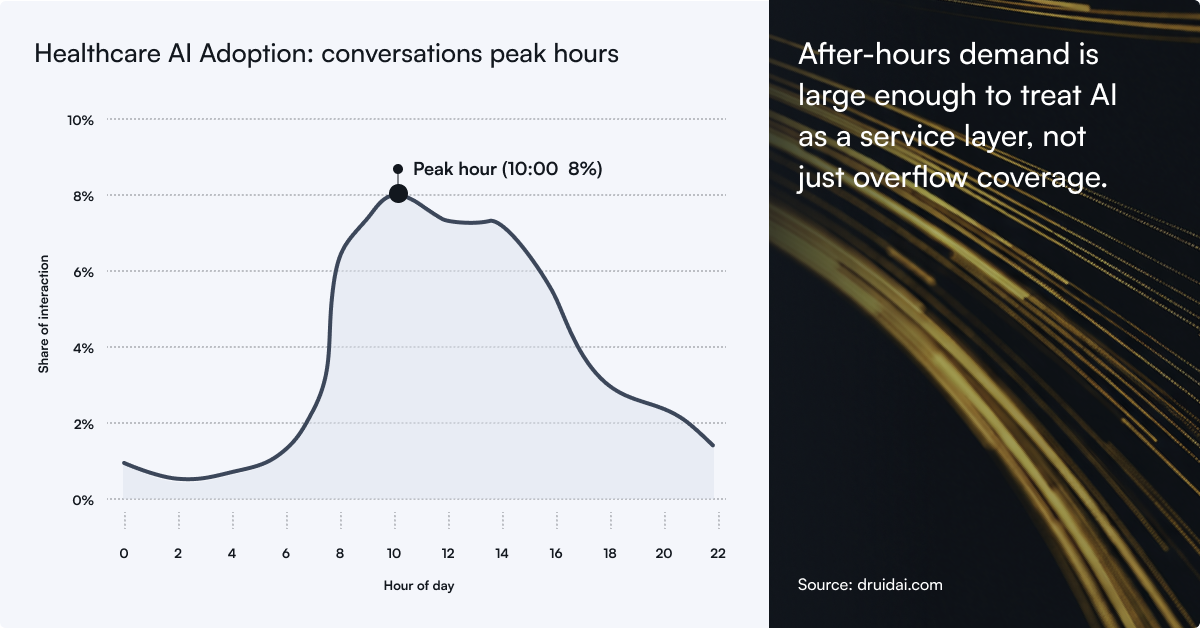
The secondary impact is access hours. As our AI Adoption in healthcare benchmark report shows nearly one-third of Healthcare AI demand arrives after hours. An AI voice agent does not have a shift. It answers at 6am, at 11pm, on weekends, on holidays. For patients who work during business hours, or who live in a different time zone from the provider, this is not a convenience. It is the difference between getting an appointment and not.
The third impact is data quality. When a human coordinator is rushing through 40 calls an hour, shortcuts happen. Fields get skipped. Insurance gets entered wrong. Demographics get guessed. A voice agent follows the same process every time, confirms every field, and writes clean data into the record.
We saw this at scale. One of the largest children’s hospitals in the U.S., processing 4.3 million patient encounters per year, deployed Druid for self-scheduling and registration. 15,000 medical record updates per week. 95% process digitization. The agent runs 24/7 in English and Spanish. That is what happens when you stop treating the phone as a legacy channel and start treating it as an automation channel.
The compliance question does not change because the channel is voice
Every voice interaction on the Druid platform runs on the same HIPAA-compliant AI agents infrastructure as text. SOC 2 Type II, ISO 27001, GDPR. On-premise deployment available. Patient data stays where it needs to stay.
Voice recordings and transcripts are handled under the same data governance policies as any other patient interaction. The EHR integration works through the same FHIR connectors and standard APIs. Epic, Cerner, the usual stack. Nothing changes architecturally because the input is a phone call instead of a chat message.
I mention this because I hear the concern often. Operations wants voice automation. Compliance wants to know if voice data introduces new risk. The answer is no, as long as the platform was built for regulated environments from the start. Druid was.

The access layer should match how patients actually behave
The argument I keep coming back to is simple. Patients do not all interact the same way. Some prefer web. Some prefer SMS. Some prefer WhatsApp. A lot of them, still, prefer the phone.
A real patient access automation strategy has to cover all of those, not just the ones that are easiest to build for. And voice is the one that most health systems have left manual the longest.
The Druid Marketplace has prebuilt healthcare solutions that work across every channel, including voice. They are built for regulated environments, they integrate with existing EHR systems, and they deploy in weeks. Not quarters. Weeks.
If your highest-volume access channel is still running on hold queues and manual coordination, that is where the ROI is. And it is available now.