AI Agent Builder
Build and ship enterprise AI agents
From idea to production in hours, not months.
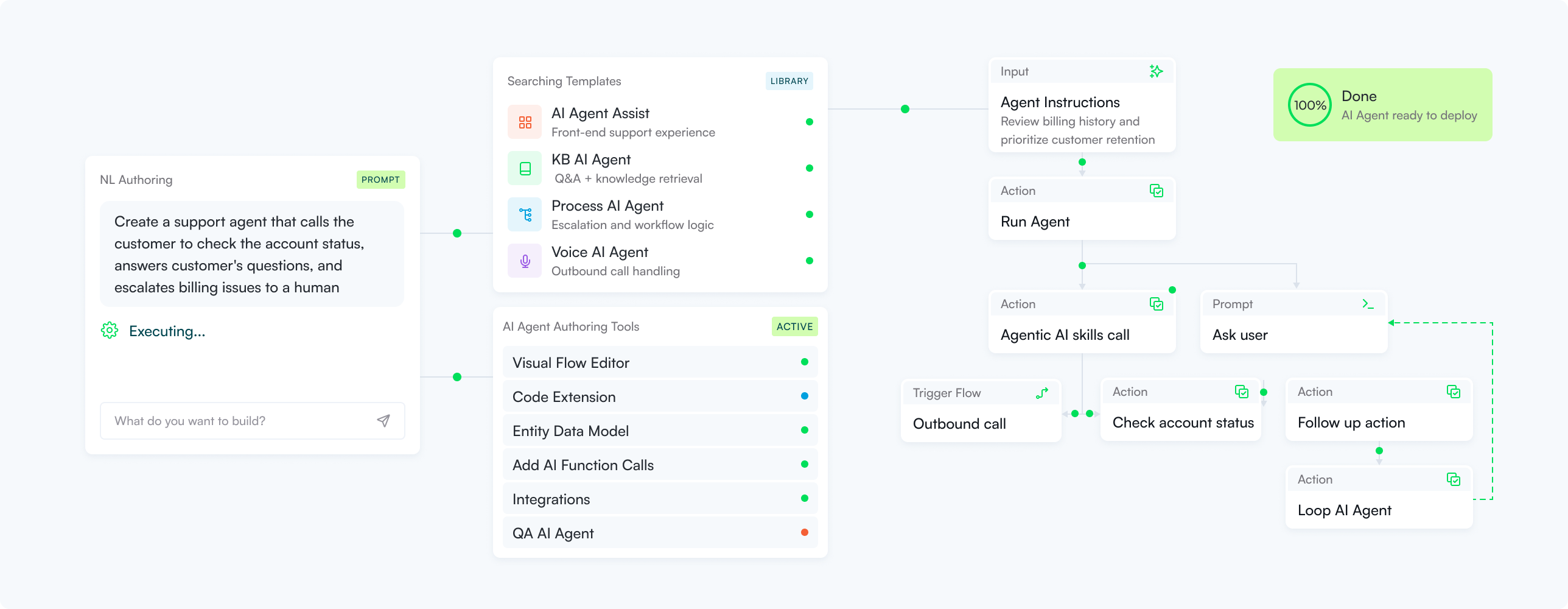
Tell what the agent should do. We wire everything else.
Get production ready flows, data models and integrations from a plain-English spec, and harden with pro-code control where it matters.
Natural language agent authoring
Define the agent's goal in plain English and generate working conversation flows, data models, integrations, and workflow logic automatically.
Visual flow editor
Model conversation paths, decision rules, and back-end actions on a low-code canvas without proprietary scripting.
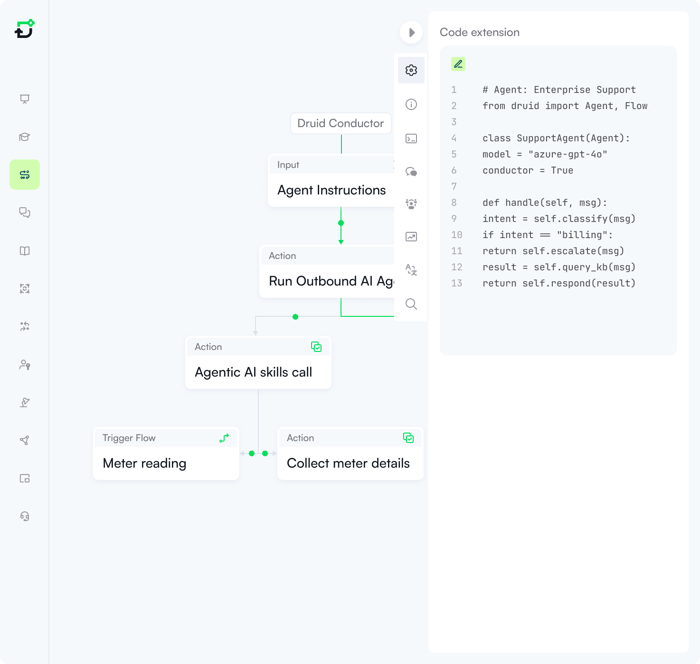
Engineering console
Fine-tune prompts, grounding sources, and retrieval strategies with real-time feedback on model and agent behavior.
Close the gap between 'I have a use case' and 'I have a working AI agent'
0%+
less dependency on specialist teams
0+
composable templates and skills to accelerate delivery
0%
traceability from intent
to execution
0min
to generate an AI agent
blueprint
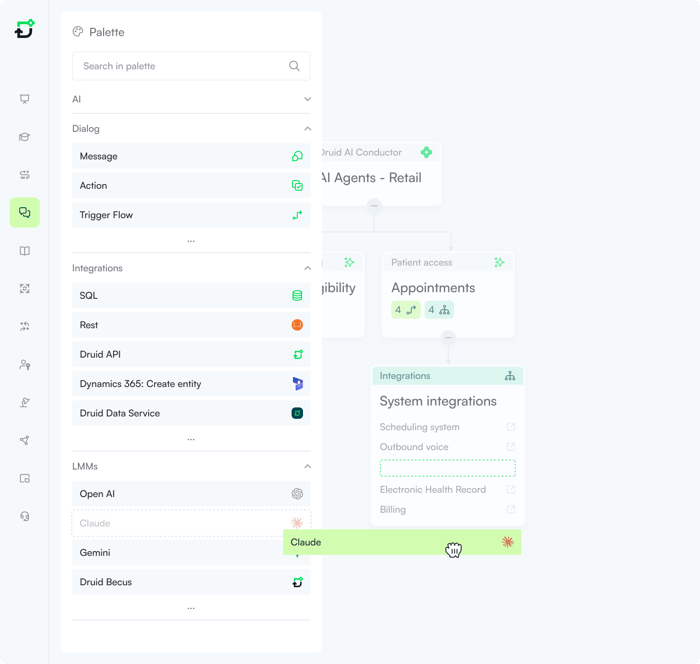
Start from proven and composable building blocks
Amaze your teams from the start with composable and reusable patterns that already align to enterprise workflows, instead of creating every AI agent from scratch.
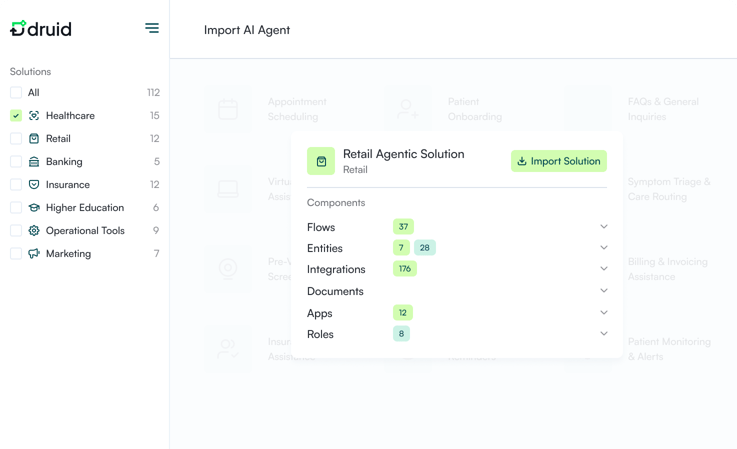
Prebuilt AI agents and solution templates
Launch faster using enterprise-ready templates and reusable components from Druid Solution Library
Integrated QA testing and validation
Run regression tests, A/B tests persona-based simulations before an agent, and reaches production.
Shared orchestration foundation
Every agent is built on the same Conductor runtime, so scale, governance, and integration come standard.
Built for both business and developers teams
Keep creation accessible without capping technical depth. Because teams can now move faster without trading away control.
No-code to pro-code continuum
Business users configure visually while engineers extend through APIs, code modules, and advanced orchestration.
Faster production handoff
Agent definitions, integrations, and tests move together so there is less friction between concept and deployment.
Governed from the start
Prompts, integrations, and workflows stay inside a controlled enterprise environment from build through launch.
Frequently asked questions
Get answers to the most common questions about Druid's AI agents and the platform's agent builder capabilities before your demo.
How fast can I generate an AI agent blueprint?
Users describe an agent’s goal in plain English. The Builder’s natural language pipeline parses the intent, queries existing AI Agents Solution Library, generates a conversation flow skeleton, infers required data models and entity slots, maps integration endpoints, and produces executable workflow logic, delivering a functional agent blueprint in under 10 minutes.
How does the visual flow editor handle decision logic?
The low-code canvas supports branching conditions, loop constructs, entity validation gates, API call nodes and integrations, and sub-flow references. Each node exposes configurable properties and connects to the Conductor runtime for execution. No proprietary scripting language is required.
What does the engineering console expose?
A pro-code workspace for advanced integrations and business logic, prompt engineering, grounding source configuration, and retrieval strategy tuning. It provides real-time feedback on response latency, confidence scores, and model behavior, enabling iterative optimization of RAG pipelines and generation quality before production deployment.
What are composable building blocks and how are they versioned?
Over 500 reusable templates from conversation flows, workflow steps, API connectors, data models, and knowledge configurations are stored in the Solution Library. Each component is versioned, dependency-tracked, and orchestrated via Conductor, so teams compose agents from proven patterns rather than building from scratch.
What data model generation does NL authoring produce?
The NL pipeline infers entity types, slot-filling rules, validation constraints, and system-of-record mappings from the goal description. These are editable in both the visual editor and engineering console and automatically wire into the Conductor execution context for downstream API calls.
How does Agent Builder handle multi-turn conversation design?
The flow editor supports stateful multi-turn dialogs with entity carry-over, context-dependent branching, disambiguation prompts, and slot confirmation loops. Conversation state persists across turns and channel switches through Conductor’s execution context.
Latest agentic AI updates from Druid AI
Connect what matters. Make work feel effortless.
See how proven AI agents work for you
Inside real systems, in real scenarios, with accuracy, reliability, and control. So your work feels simpler, not harder.