Druid 2026 AI Adoption Usage Benchmark
AI Adoption in Higher Education Benchmark: What 15 months of production data actually reveals
Most higher education AI reports show what leaders plan to do. This benchmark shows what happens once AI is live in student-facing service journeys: where usage lands, which experiences carry the volume, and what real-world deployments look like day to day.
Survey-based “State of AI” content dominates the higher ed conversation, and it does a fine job capturing sentiment and budget intent. Production usage is a different question: what actually happens once AI sits inside live student-service journeys.
That gap matters. If you’re evaluating AI for your institution, you need a practical frame of reference: where demand concentrates, which channels dominate, how often students can stay in self-service, and where human handoff still matters.
The benchmarks below focus on that operational reality. They show how higher education AI is used in production today across Druid Higher Education Customer Experience (CX) deployments, expressed as percentage distributions so you can compare shape and signal.
INSIGHT 01
Top use cases cluster around student FAQs and service support
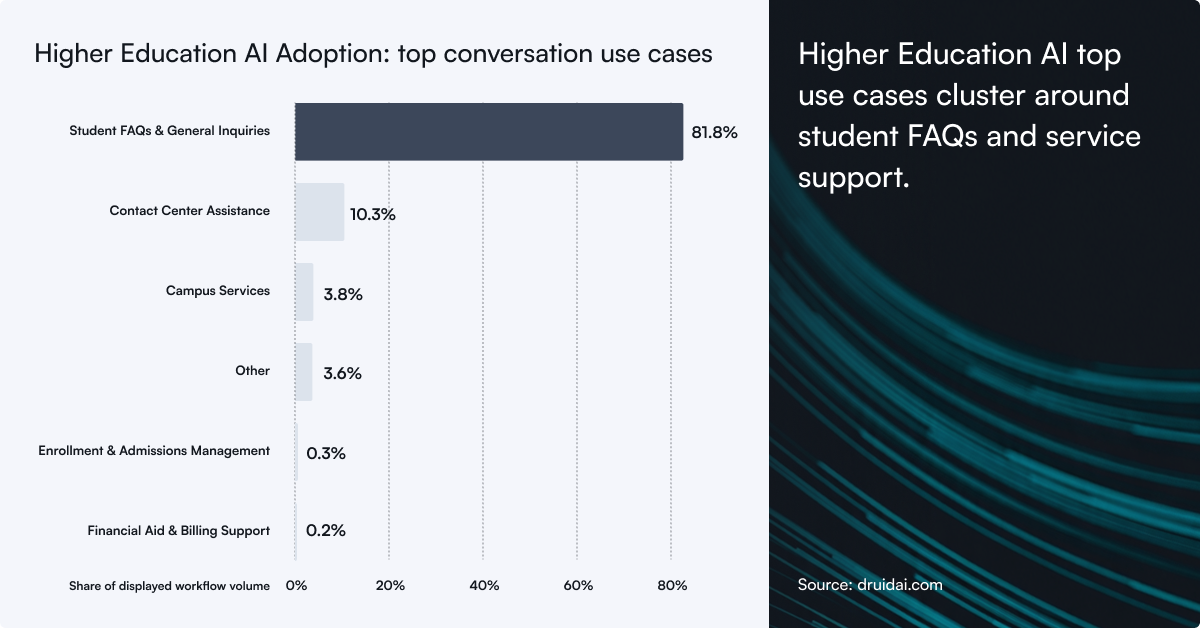
Student FAQs & General Inquiries account for 81.8% of Higher Education CX workflow volume. That’s the central planning signal: production demand is anchored in high-frequency student questions. Many of those “FAQ” moments also depend on data and context from systems such as the SIS, CRM, student portal, and financial aid systems, plus approved institutional knowledge sources. The label undersells the work behind them.
Contact Center Assistance contributes 10.3%, and Campus Services adds 3.8%. Enrollment management and financial aid are smaller but operationally important workflows. They look like low-volume categories, yet they still trigger knowledge workflows when students ask about application status, next steps, registration, aid eligibility, billing, holds, deadlines, or degree requirements.
So the benchmark is highly concentrated, and it still extends into concrete student-service workflows beyond general inquiries. Here’s the distinction that matters: a “general inquiry” can require a very specific answer. A student may open with a broad question, but the right response often needs institution-approved knowledge, student-specific context, or routing into an enrollment, registrar, financial aid, or campus-service workflow.
FAQ dominance tells you where institutional complexity first surfaces: at the student-service front door. Students experience registrar, admissions, financial aid, housing, IT, and campus services as one institution. The next maturity step connects those high-frequency questions to governed workflows, approved knowledge, and system-aware actions.
INSIGHT 02
AI adoption in higher education is overwhelmingly chat-first
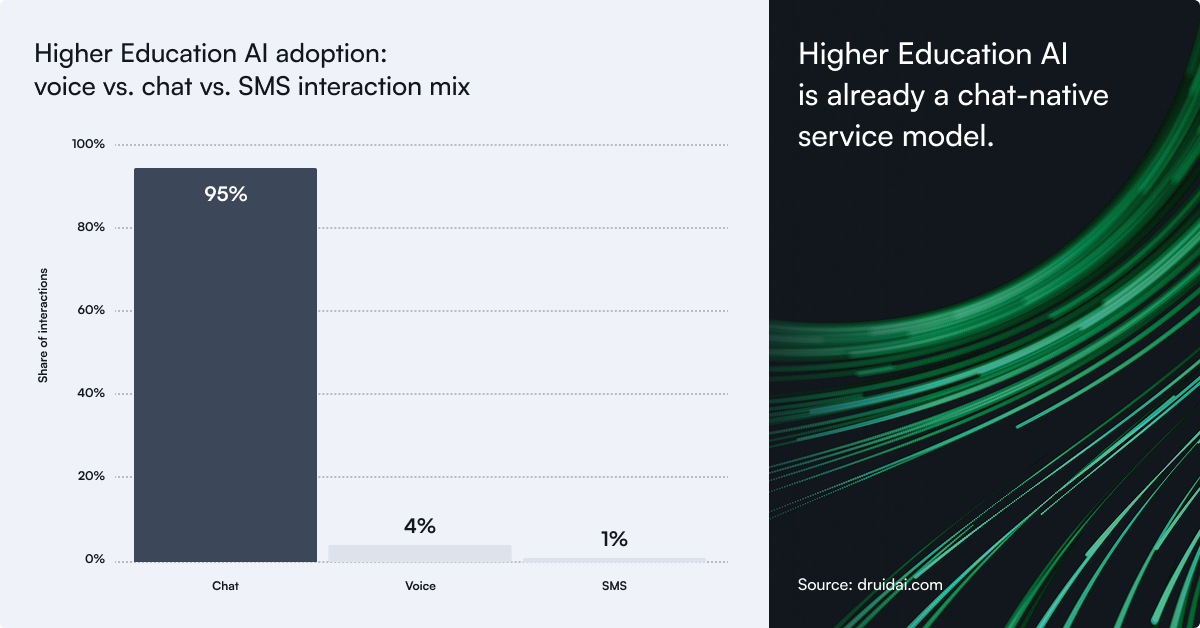
Chat accounts for 95% of engaged Higher Education CX interactions. Voice sits at 4% and SMS at 1%. That fits how many students want support: quick, text-based help they can reach in the flow of the day. Chat is the primary operating surface for student-facing AI, and it deserves to be resourced that way.
Student behavior is pulling this adoption. Chat is where students already expect fast, low-friction help, and for most of them it feels more natural than voice: it’s immediate and private, and it works between classes, during a shift at work, or on the commute. Make chat the primary student-service interface, governed by institutional policy and connected to the systems and teams needed to complete the journey.
INSIGHT 03
Demand peaks midweek, but the weekend tail is real
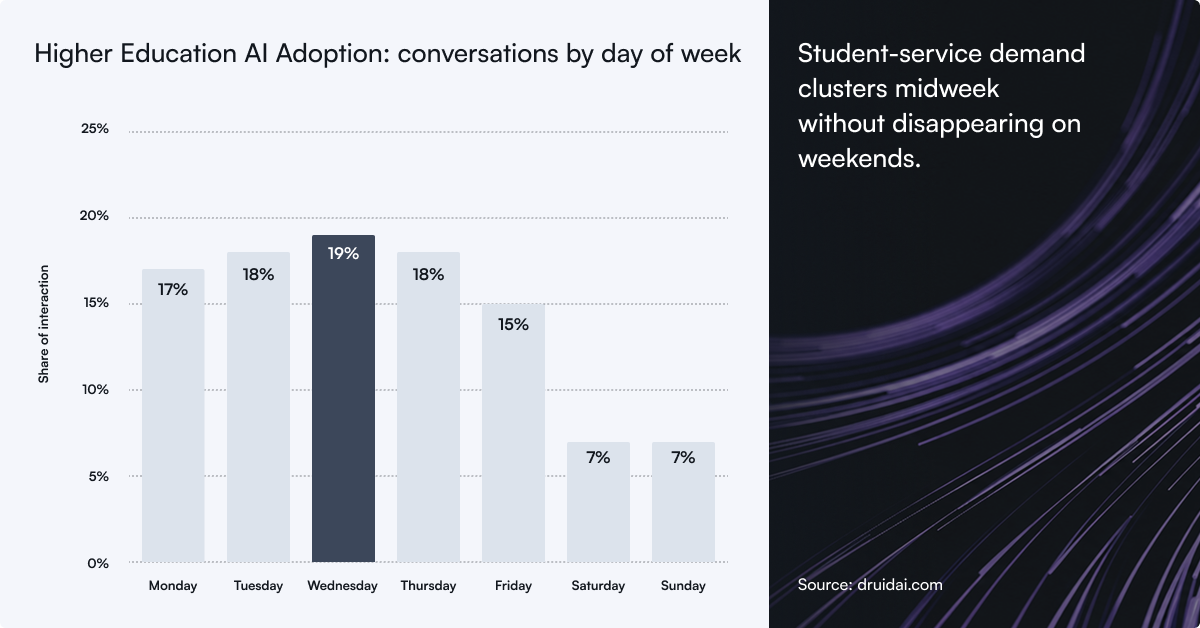
Wednesday accounts for 19% of total Higher Education CX interactions. Tuesday through Thursday contributes 55%, and the weekend still carries 14%. The shape points to a student-service rhythm driven by weekday academic and administrative activity that keeps running after offices close.
Student life runs past business hours and through the weekend. Demand is strongest during the academic week, sure. But that 14% weekend share means student-service needs keep arriving while offices sit closed. Build weekend demand into your AI planning as part of a 24/7 student-support model.
INSIGHT 04
Students do not keep office hours, and AI availability cannot either
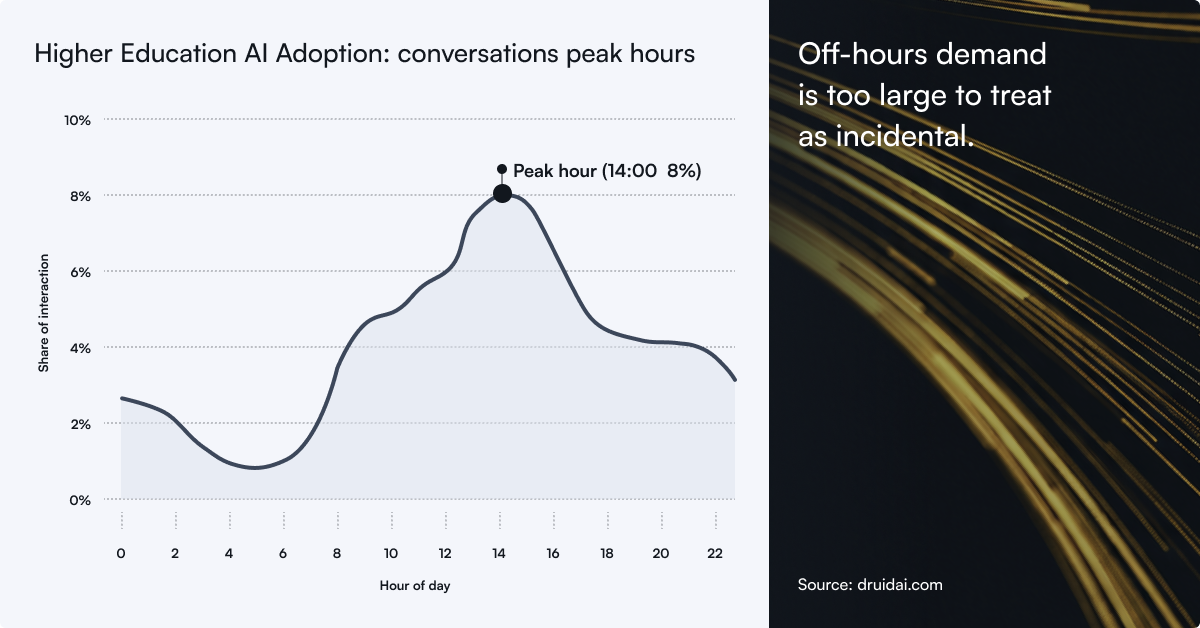
61% of Higher Education CX interactions land between 8 AM and 5 PM, with the single busiest hour at 2 PM (8%). The other 39% arrives outside that window. If you work in higher ed, that won’t surprise you: students study, plan, register, and resolve administrative questions at night and in the margins of the day. Always-available AI agents keep service running through those hours.
That 39% off-hours share should change how you think about support coverage. It’s a structural gap between when students need help and when campus offices are staffed. For admitted students, unanswered questions after hours compound into missed next steps, unresolved financial aid issues, incomplete registration, and eventually summer melt. For first-year students, the same friction delays support, builds frustration, and chips away at retention.
Always-available AI agents protect these transition moments. They keep students informed and moving forward while campus offices are closed.
INSIGHT 05
Most conversations stay contained
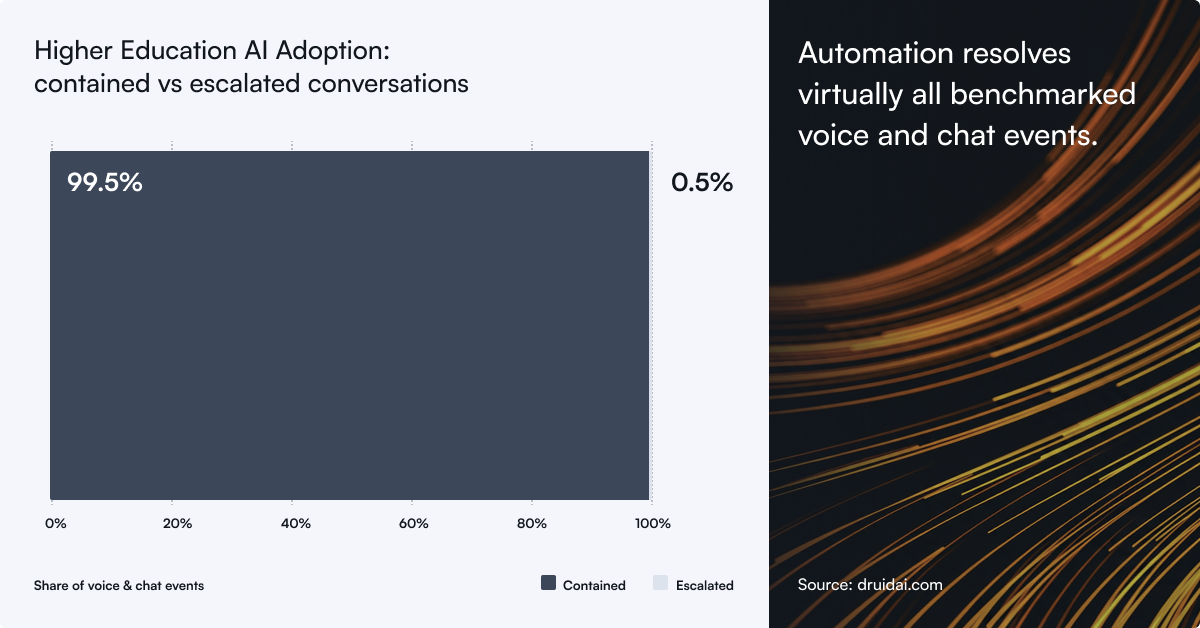
Contained events account for essentially 99.5% of aggregate voice and chat events; escalations round to 0.5%. An escalation is often the right outcome, though. In production student-service journeys, some handoffs are intentional because policy, exception handling, identity-sensitive work, or live staff involvement is what the moment calls for.
High containment says many student-service interactions are repeatable and automation-ready. Human support still matters, and escalation quality stays critical for policy-sensitive, identity-sensitive, or exception-based journeys. The operating model that works in higher ed: resolve what can be resolved, route what must be routed, and preserve context when a human steps in.
What this means for higher education leaders evaluating AI solutions
Production telemetry points to a student-service operating model grounded in observed demand. The benchmark shows where students actually turn for help, when they engage, and which service patterns institutions need to plan around.
The model is chat-first by a wide margin, and student behavior is what’s pulling it there. Students expect fast, text-based, low-friction support, so treat chat as the primary operating surface for student-facing AI.
The workflow mix concentrates in the right starting point. Student FAQs and general inquiries carry most of the displayed workflow volume, while contact center assistance, campus services, enrollment and admissions, and financial aid and billing represent smaller but operationally important categories. High-frequency student questions are the natural entry point for building a broader, governed student-service layer.
Timing patterns complete the picture. Demand clusters during the academic week, but weekend and off-hours usage is too meaningful to treat as an edge case. That matters most during transition moments: admitted students navigating next steps, financial aid, and registration are vulnerable to summer melt, and first-year students who can’t get questions answered quickly hit avoidable friction that weakens retention.
The takeaway: in production, AI is becoming a 24/7 student-service operating layer. It helps institutions answer repeatable questions, protect student momentum, reduce service friction, and support enrollment and retention outcomes at scale.
Methodology
Source: anonymized aggregate usage data from Druid's global higher education customers from Jan 2025 to March 2026.
Normalization: every visual expresses share of the relevant total as a percentage, rather than showing raw counts.
Get your copy of the 2026 AI Adoption Benchmark report
Download the PDF report to explore what 15 months of Higher Education production AI agent usage reveals about real-world adoption, service demand, and resolution.