Druid 2026 AI Adoption Usage Benchmark
AI Adoption in Healthcare Benchmark: What 15 months of production data actually reveals
Survey-based State of AI content dominates the healthcare conversation. Surveys capture sentiment, budget intent, and board-level urgency. Production usage answers a different question: what patients and staff do once AI is live inside patient-facing service journeys.
That gap matters. A leader evaluating AI needs a practical frame of reference: where demand concentrates, which channels dominate, how often patients stay in self-service, and where human handoff still belongs.
The benchmarks below cover that operational ground. They draw on 15 months of live production data from Druid Healthcare Customer Experience (CX) deployments and show where usage lands, which experiences carry the volume, and what healthcare leaders should expect from real-world deployments. Every figure is expressed as a percentage distribution, so leaders can compare shape and signal.
INSIGHT 01
AI adoption in healthcare starts with patient access, identity, and FAQs
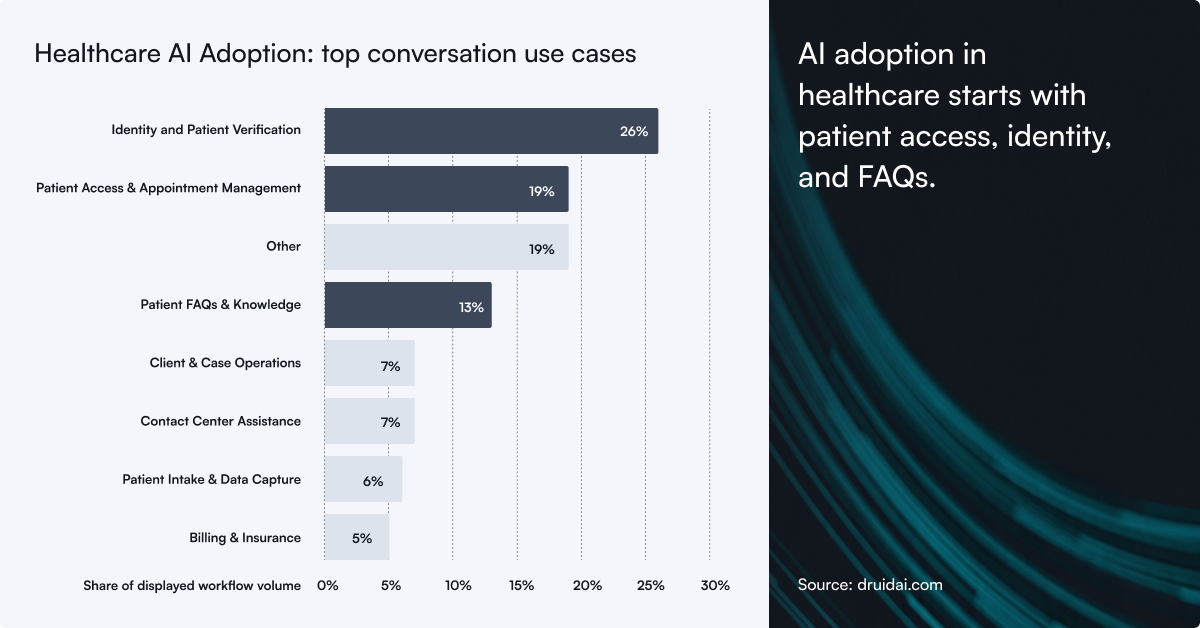
Patient Identity & Verification accounts for 26% of Healthcare CX workflow volume. Patient Access & Appointment Management adds 19%, and Patient FAQs & Knowledge another 13%. Together, those three front-door workflow types make up 57% of the published mix. AI adoption in healthcare demand starts with access, verification, and common patient questions.
The next layer matters too. Clinical & Case Operations, Contact Center Assistance, Patient Intake & Data Capture, and Billing & Insurance contribute another 24% combined. Production demand extends past front-door routing into care-adjacent coordination, agent support, intake capture, and the patient financial journey.
Clinical & Case Operations (7%) and Contact Center Assistance (7%) show healthcare AI already supporting staff-facing service work. Patient Intake & Data Capture (6%) and Billing & Insurance (5%) tie adoption directly to administrative and financial-service workflows.
The fastest path to healthcare AI scale starts at the front door. Prove measurable ROI on high-volume administrative workflows like patient access and identity verification, then expand into patient intake, billing, contact-center assistance, and care-adjacent coordination, where deeper workflow orchestration, system integration, and governed handoffs come into play.
INSIGHT 02
AI adoption in healthcare is nearly split between voice and chat
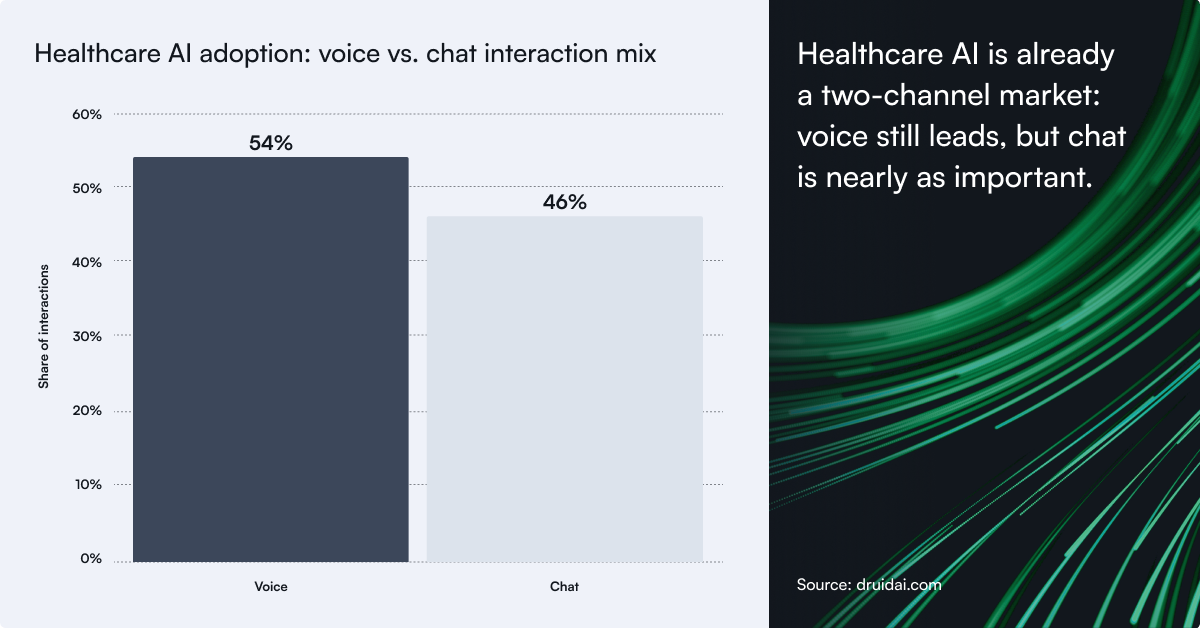
Voice accounts for 54% of engaged Healthcare CX interactions, and chat accounts for 46%. Voice still leads, but chat is close enough that healthcare leaders should treat both as first-class service channels.
Voice is a defining requirement for healthcare AI. In Druid’s AI adoption benchmark, healthcare shows stronger voice reliance than industries such as Higher Education or Banking. That fits the service environment: patients often need appointment support and reassurance in the moment, and older patient populations tend to be more comfortable resolving healthcare needs by phone.
Voice is table stakes. The trap is building it as a separate automation project. Look for an AI solution that supports voice and chat with the same knowledge, business rules, integrations, and escalation logic, so the experience only gets built once.
INSIGHT 03
Healthcare AI demand peaks at the start of the workweek
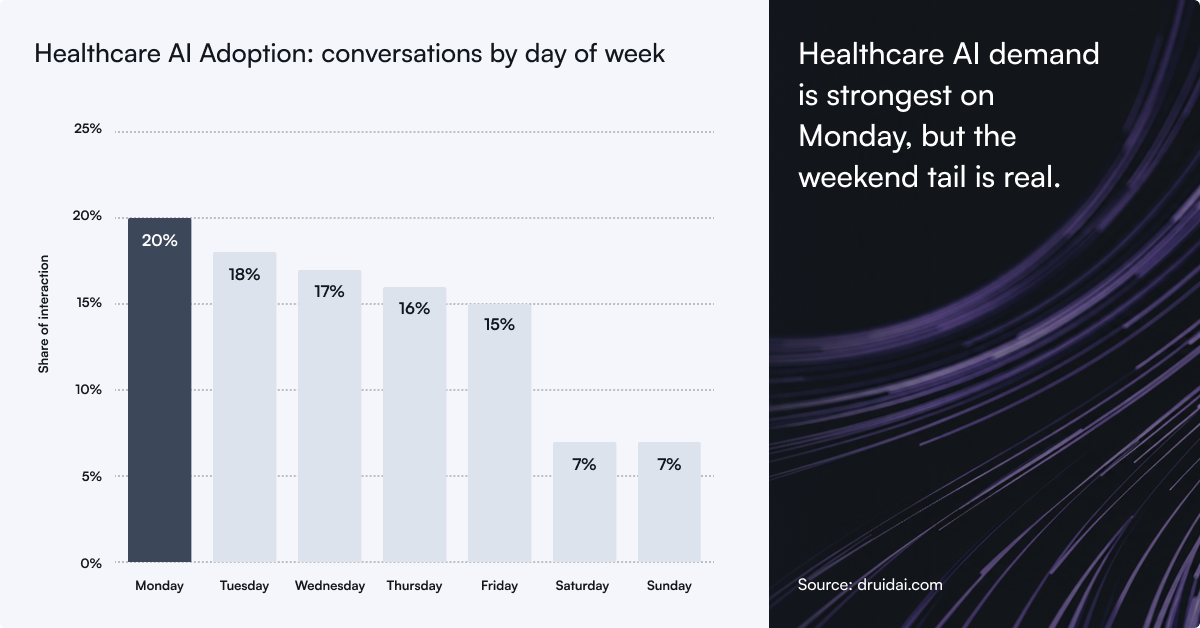
Monday accounts for 20% of total Healthcare CX interactions, the highest share of any day in the dataset. Monday through Friday carries 86% of volume overall, and the weekend still contributes 14%. The steady decline through the week suggests demand builds as patients enter the workweek, then tapers as administrative and access needs get resolved.
Monday is the operational stress test for patient access. Accumulated patient needs and administrative queues converge at the start of the workweek.
AI that only answers questions helps at the margin. AI that completes workflows can flatten the weekly workload curve: rescheduling, confirming appointments, collecting intake data, answering coverage questions, and routing exceptions. The practical opportunity is to reduce Monday load before it becomes call-center congestion.
INSIGHT 04
Nearly one-third of Healthcare AI demand arrives after hours
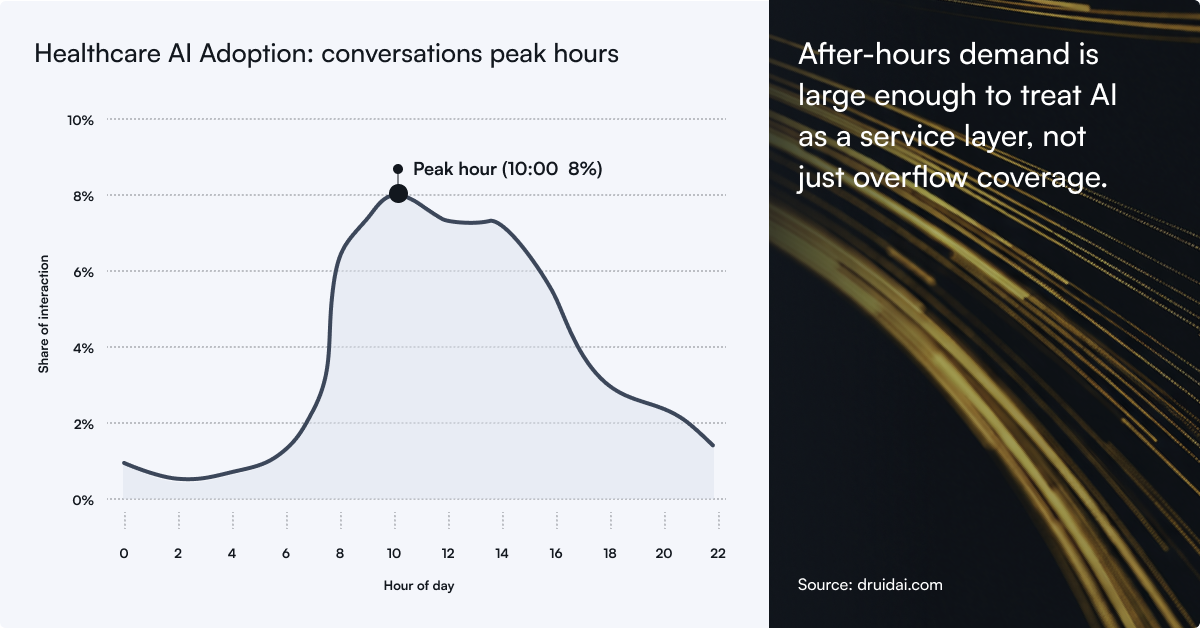
71% of Healthcare CX interactions land between 8 AM and 5 PM, with the single busiest hour at 10 AM (8% of volume). The other 29% arrives outside that window. The pattern supports a practical view of AI as a digital employee layer: it absorbs daytime load and keeps service available when staffing thins after hours.
After-hours AI captures patient intent at the moment it occurs. Without it, that intent lands in tomorrow’s queue, a next-day phone backlog, or another provider’s access path.
INSIGHT 05
Most Healthcare AI conversations stay contained
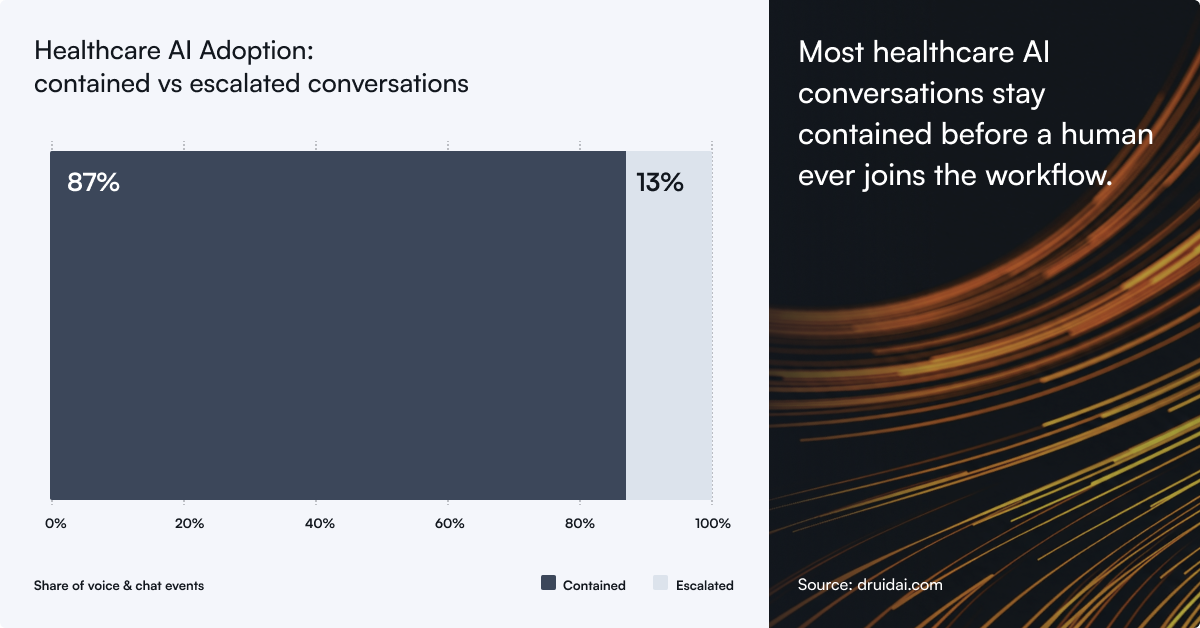
Contained events account for 87% of aggregate voice and chat events, and escalations account for 13%. Many escalations happen by design: business rules intentionally bring in a human agent when a workflow requires policy review, exception handling, or live staff involvement. The signal: automation contains most demand while handing off the cases built for human participation.
In healthcare, containment only works as a metric if patients can still reach human support when they need it. The better executive measure is governed resolution: AI resolves repeatable work, follows approved rules, and escalates exceptions at the right moment with the right context.
What this means for healthcare leaders evaluating AI solutions
Druid’s AI adoption in healthcare telemetry gives leaders a practical planning model based on observed usage.
The strongest workflow concentration sits in patient access, identity, and FAQs, while care-adjacent coordination, contact-center assistance, intake, and billing extend the benchmark past simple front-door routing. The fastest path to value starts with high-volume administrative workflows, then expands into deeper workflow orchestration.
The benchmark points to a two-channel healthcare AI model. Voice leads at 54%, chat follows at 46%, and both belong in the plan as core service channels. The priority is one AI service layer that applies the same knowledge, business rules, integrations, and escalation logic across both.
Containment, timing, and day-of-week patterns complete the picture. Most conversations stay contained, demand is weekday-led, and a meaningful share still arrives outside 8 AM to 5 PM. Taken together, that positions AI as an operating layer for patient access, service continuity, and staff efficiency. Measure it as governed resolution: healthcare AI has to know when to resolve, when to retrieve approved knowledge, and when to bring in a human with context.
The practical mandate: win the administrative front door first, support voice and chat from one unified AI foundation, use governed resolution as the success metric, and scale into intake, billing, contact-center assistance, and care-adjacent workflows from there.
Methodology
Source: anonymized aggregate usage data from Druid's global healthcare customers from Jan 2025 to March 2026.
Normalization: every visual expresses share of the relevant total as a percentage, rather than showing raw counts.
Get your copy of the 2026 AI Adoption Benchmark report
Download the PDF report to explore what 15 months of Healthcare production AI agent usage reveals about real-world adoption, service demand, and resolution.